
The Supervisory Authority “Disagreement” Continues On The Supreme Court
Posted: October 16, 2015 Filed under: Appellate Law | Tags: inherent supervisory powers Leave a commentToday, for the second time in two weeks, the Connecticut Supreme Court took the unusual step of publishing on its website an order denying a motion for rehearing in a case. (Opinions resolving appeals are always published; rulings on motions for reargument are almost never written, much less published.) Two justices–Zarella and Espinosa–dissented from the court’s decision denying the state’s motion for reargument in In re: Yasiel R., a case involving the termination of parental rights. In that case a majority of the court rejected the appellant’s claim of constitutional error in the termination proceedings, but then proceeded to invoke the court’s “inherent supervisory authority over the administration of justice” to make up a new rule concerning termination proceedings. The court then applied that new rule retroactively to provide relief to the appellant. Justices Zarella and Espinosa both issued strong dissents.
Second Circuit Says Copyright Law Allows Google To Digitize And Index Published Works
Posted: October 16, 2015 Filed under: Uncategorized Leave a commentBreaking news from the Second Circuit! Here is the headnote for the just-released decision:
Plaintiff-appellants, who are authors of published books under copyright, appeal from the judgment of the United States District Court for the Southern District of New York (Chin, J.) in favor of Defendant Google, Inc. Plaintiffs sued Google, alleging that its Library Project and Google Books project infringe Plaintiffs’ copyrights. Through these projects, Google makes and retains digital copies of books submitted to it by major libraries, allows the libraries that submitted a book to download and retain a digital copy, and allows the public to search the texts of the digitally copied books and see displays of snippets of text. The district court granted summary judgment based on its conclusion that Google’s copying is fair use under 17 U.S.C. § 107 and is therefore not infringing. The Court of Appeals concludes that the defendant’s copying is transformative within the meaning of Campbell v. Acuff-Rose Music, Inc., 510 U.S. 569, 578-585 (1994), does not offer the public a meaningful substitute for matter protected by the plaintiffs’ copyrights, and satisfies § 107’s test for fair use. AFFIRMED.
It Ain’t Over Till It’s Over
Posted: October 8, 2015 Filed under: Uncategorized 1 CommentNo, I’m not referring to Yogi Berra’s recent passing. No, I’m not referring to Lenny Kravitz’s 1991 song. Yes, I am referring to the status of the death penalty in Connecticut.
Connecticut Supreme Court Denies Reargument In Death Penalty Abolition Case
Posted: October 8, 2015 Filed under: Uncategorized Leave a commentOver the strong dissent of three justices, the Connecticut Supreme Court today denied the State’s motion for reargument in State v. Santiago, the case decided last August which abolished the death penalty in Connecticut. Click here for my previous posts on the decision.
The denial of the motion for reargument is not unusual. What is unusual is the written dissent from the ruling and its publication on the Judicial Branch’s website. Decisions are always posted on the website; rulings on motions are not.
It’s The First Monday In October. . . .
Posted: October 4, 2015 Filed under: Uncategorized Leave a commentAnd that means the United States Supreme Court is back in session! Whether that is a good thing or a bad thing depends on your perspective; the court will decide some highly charged cases this year and those decisions are sure to delight–or enrage–depending on where you stand on the issues. Click below for a look at the upcoming term from several different perspectives:
Adam Liptak (New York Times)
Elizabeth Slattery (The Heritage Foundation)
Richard Wolf (USA Today)
Gabriel Malor (Hot Air)
Coming Your Way Soon: The Little Book Of Big Appellate Tips!
Posted: October 2, 2015 Filed under: Appellate Law, Practice and Procedure Leave a comment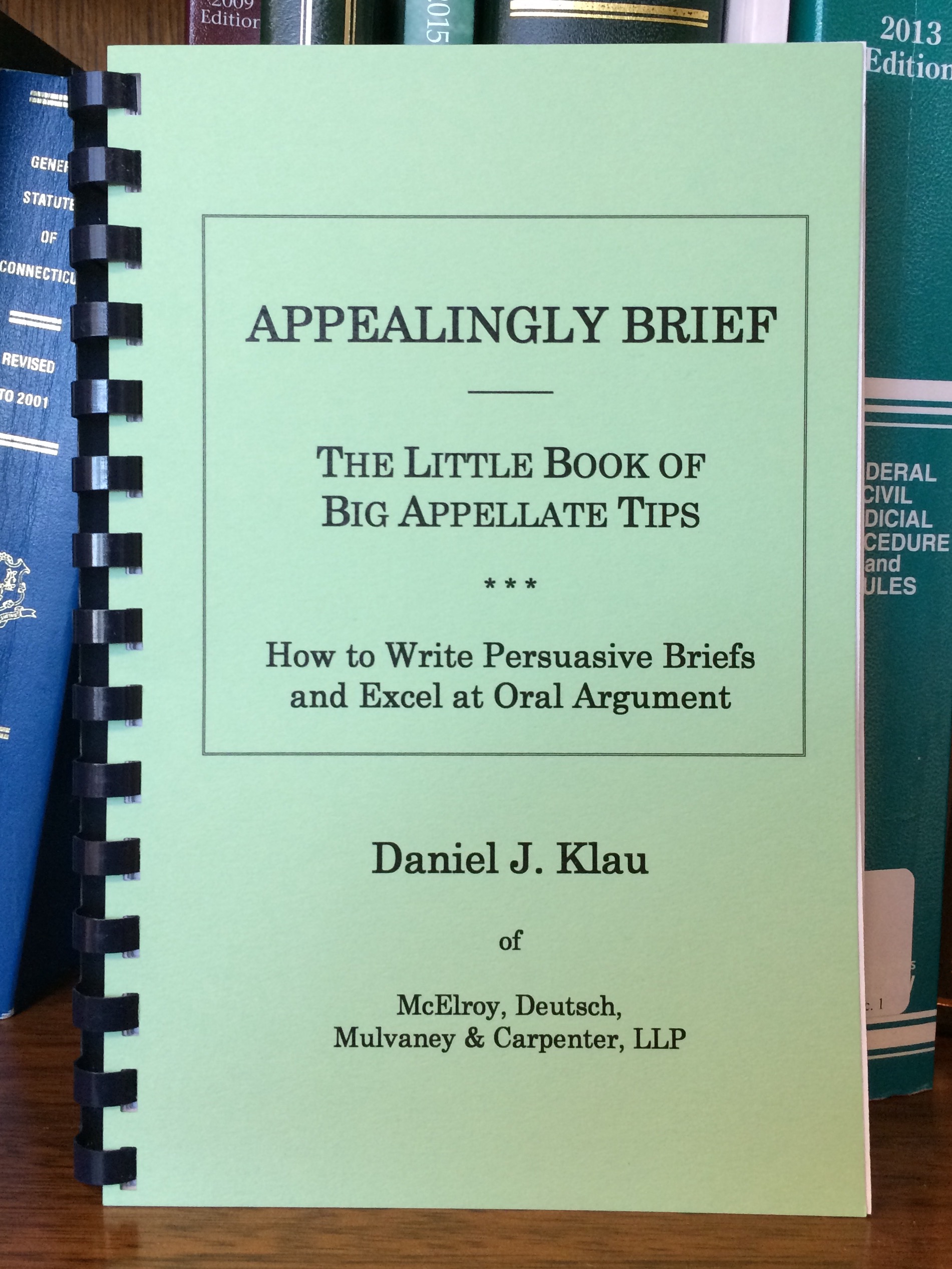
I’m very pleased to announce that I’m on the cusp of releasing my first book, Appealingly Brief: The Little Book of Big Appellate Tips (Or How to Write Persuasive Briefs and Excel at Oral Argument). Click here for more information about the book, including a free excerpt in pdf format. The full book will be published later this fall in both print and e-book formats.
The book contains 37 specific tips, many with multiple sub-tips, pointers and suggestions, on brief writing and oral argument. While I would like to take sole credit for these tips, the truth is that they represent the collective wisdom of brilliant jurists and appellate lawyers like former Connecticut Supreme Court Chief Justice Ellen Ash Peters, former Wiggin & Dana appellate guru (and later federal district judge) Mark Kravitz, and so many other very wise folks, including but not limited to former Supreme Court Justices David Borden, Joette Katz, Barry Schaller and Ian McLachlan.
Stayed tuned for further information on the official publication date.
What Will Justice Robinson Do In Peeler? (Or Is The Death Penalty Really Dead In Connecticut?)
Posted: September 29, 2015 Filed under: Appellate Law | Tags: death penalty, public act 12-5 2 CommentsWhen the Connecticut Supreme Court issued its recent 4-3 decision in State v. Santiago striking down the death penalty in Connecticut, most people thought that was the end of the story–whether they agreed with the decision or not.
I’m not so sure.
When Felons Run For Public Office, Ctd.
Posted: September 18, 2015 Filed under: General Law | Tags: felon, ganim Leave a commentWell, by a narrow margin voters in the Bridgeport Democratic primary have chosen their former mayor, convicted felon Joseph P. Ganim, to represent them as their candidate in the mayoral election in November. Unbelievable.
I wrote a post last March discussing the Connecticut law that allows felons to run for public office, but only if they have made “payment of all fines in conjunction with the conviction and once such person has been discharged from confinement, and, if applicable, parole.” I asked in that post whether Mr. Ganim had, in fact, paid all fines.
A Death Penalty Hypothetical, Ctd.
Posted: September 6, 2015 Filed under: Uncategorized Leave a commentLast week The CT Mirror ran my prior post, “A Death Penalty Hypothetical For The Connecticut Supreme Court, as an op-ed. It generated a comment from a person identified as “David Rosen.” I assume this to be the always thoughtful attorney David Rosen from New Haven. He makes a good point, to which I would like to respond. Let me first restate the hypothetical I posed:
ACLU Files Motion To Hold Kentucky Clerk In Contempt
Posted: September 2, 2015 Filed under: Uncategorized Leave a commentKim Davis is the Rowan County, Kentucky clerk (an elected position) who refuses to issue marriage licenses to same-sex couples because she says doing so offends her religious beliefs. On August 12, 2015, a federal court granted certain plaintiffs’ request for a preliminary injunction ordering Davis to comply with the law of the land and issue licenses to such couples. She continues to argue that she has the right to flout the law because of her religious beliefs.
 Appealingly Brief!